Beyond the Walls: Art, History & the Power of Conversation
At the Museum of Contemporary Art Connecticut (MoCA\CT), Looking for History explores the walls we build, both physical and metaphorical, inviting conversations about history, identity, belonging and our shared future. It asks, “Can art help break down the barriers that divide us?”
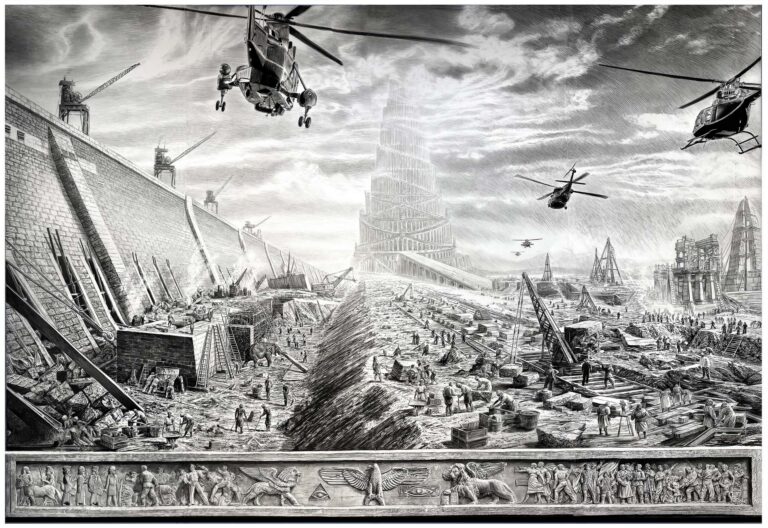
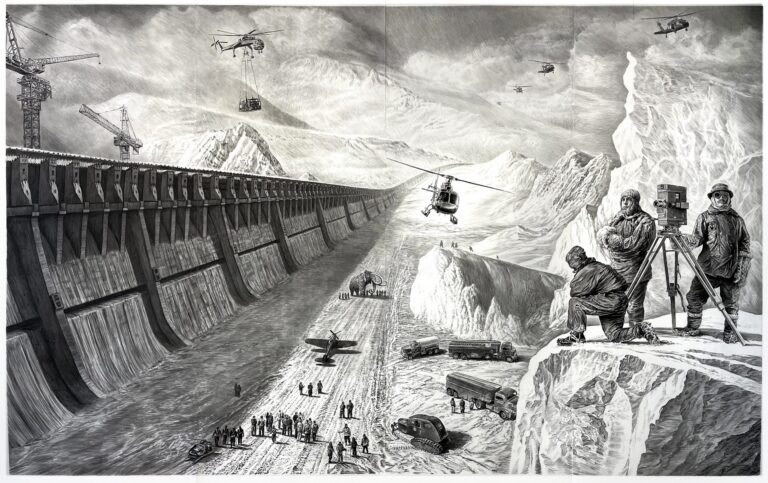
At the heart of the MoCA\CT exhibition series is Colossi – monumental charcoal drawings by Connecticut-based artist Rick Shaefer, examining why humans have built walls throughout history – to protect, divide and define – and why we continue to build them today.
CORA Foundation was pleased to support four public Community Conversations, helping to bring these questions beyond the exhibition and engage the local community.
In this conversation, artist Rick Shaefer, CORA President Robin Tauck and MoCA\CT Executive Director Robin Jaffee Frank explore the inspiration behind Shaefer’s work, the role of museums as gathering spaces, and the power of community conversations to bring people together.
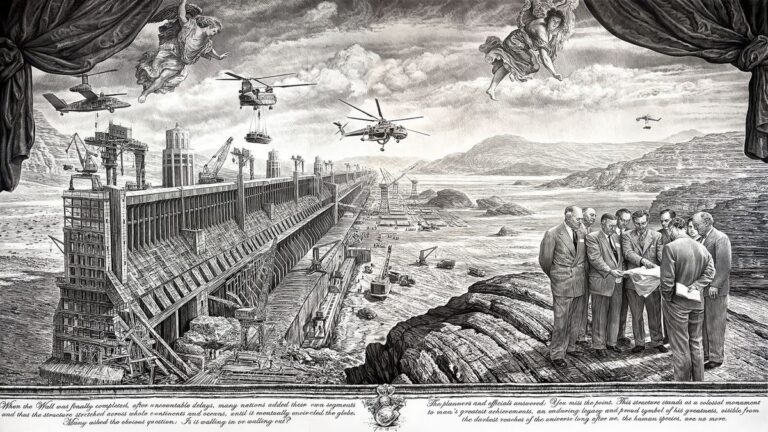
Rick Shaefer, The New Colossus (2018-2020), charcoal on synthetic vellum (five panels), 114 x 180 inches
Behind the Artwork
For Shaefer, the inspiration began with a reaction to contemporary debates about building walls and soon developed into a much broader exploration of humanity’s long history of constructing barriers. Walls have existed since the earliest civilizations, built to provide protection, define territories and establish boundaries. Yet they also serve to separate and exclude. For Shaefer, this contradiction became central to his work.
“When I started working on this piece, it became more and more complex and more and more about not just border walls, but walls in general and separations,” he said.
“It is what keeps us apart, what brings us together. I was trying to add all these little historical elements to show that wall building has been part of our DNA from the beginning.”
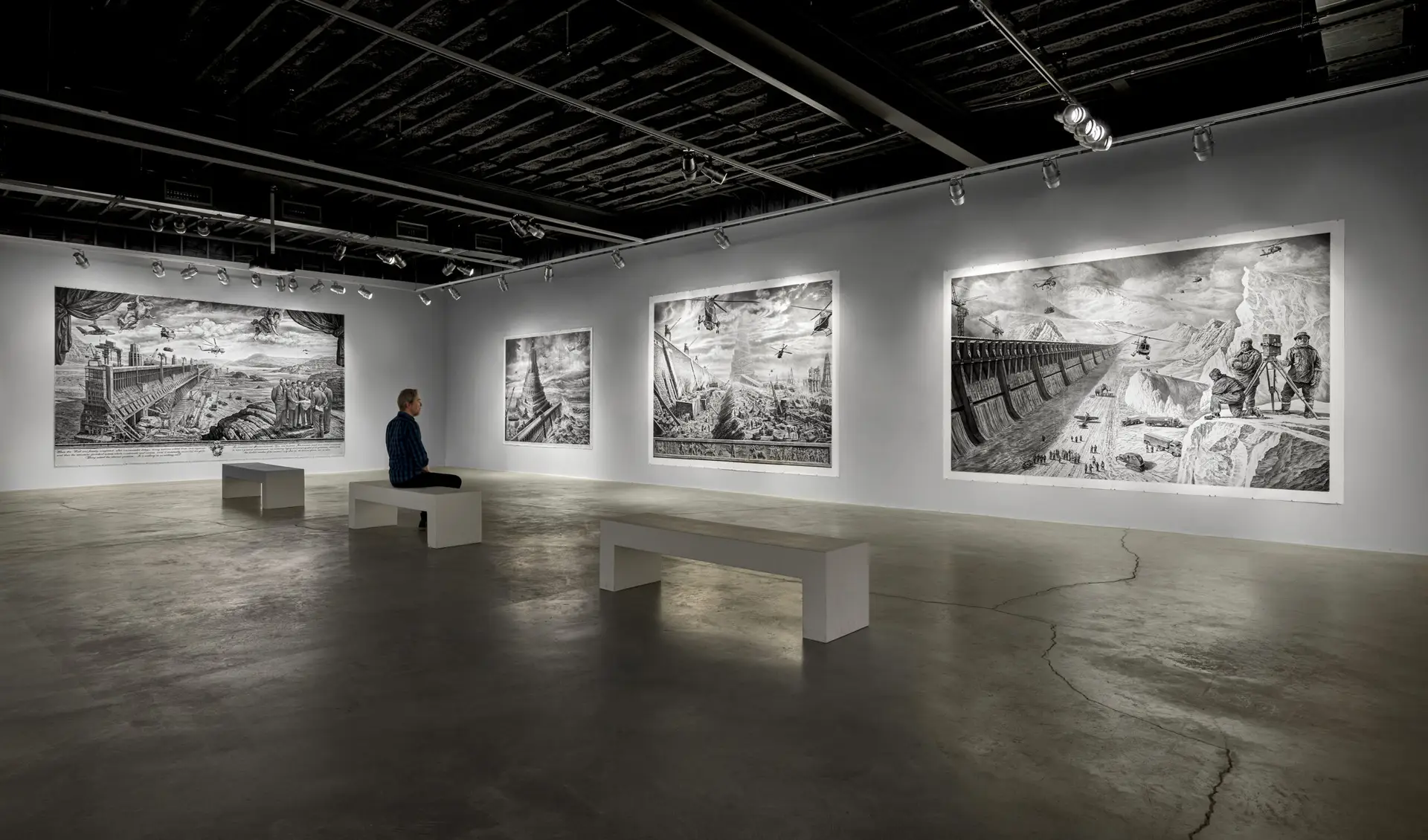
The enormous scale of the drawings is intentional; it reflects an open question around the need for walls. Their presence draws audiences into the subject, while their intricate details invite closer inspection.
“You can either stand back and look and ponder, ‘What is the message here?’ Or you can go right up close to these charcoals and examine really, literally hundreds of pieces within the piece,” Tauck observed. Drawing on her experience working with US World Heritage stewardship, she recognized historical sites and landscapes among the drawings’ many details.
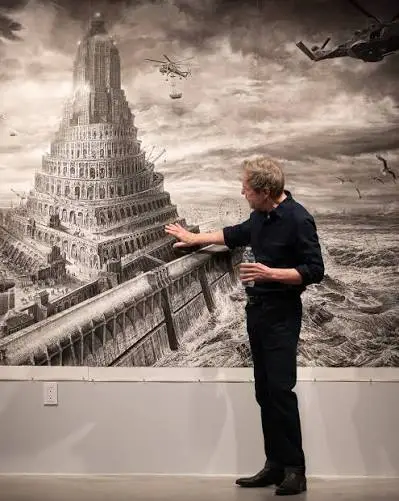
Rick Shaefer at MoCA\CT - Siege (2023), charcoal on synthetic vellum (three panels), 84 x 114 inches
Throughout the conversation, Shaefer was clear to explain that although audiences frequently interpret the works through a political lens, he is less interested in communicating a particular position and more interested in encouraging reflection.
This is evident in the programming built around the exhibition, which invite people from all ages to join the conversation, through a series of events at the museum.
“I love coming [to the museum] to have the conversation, and listening to other people’s perspectives,” Tauck explained, adding that hearing the expertise from others brought together in the series is incredibly important to her.
Tauck went on to reflect on an exchange she had at one of the Community Conversations, with Rick Bell, an architect, professor, and acting director of Columbia University Center for Buildings, Infrastructure and Public Space.
“He entered the conversation beautifully,” she added. “He particularly spoke to the lower East Side [of Manhattan], and the building of seawalls and the expanded parks, foreseeing the erosion and the serious situations after Hurricane Sandy.”
Shaefer agreed, and went on to explain a conversation they continued after the event. “There’s no easy answer to [the issue of environmental threats]. Coming up with that answer is actually very difficult,” he said.
"The artist does the work, but once it gets out in the public, that's when it really starts to blossom and take on relevance."
Rick Shaefer, The Eastern Wall (2025), charcoal on synthetic vellum (four panels), 109 x 149 inches
Why Conversation Matters
In many ways these exchanges highlight how the Community Conversations program offers an illustration of cultural diplomacy in action: using art as a starting point for dialogue, bringing different perspectives together and connecting creative expression with the real-world challenges facing communities.
For Frank, these opportunities are fundamental to the role of a museum. “Unless we bring people together to closely look at the works of art and to get in conversation with one another, it doesn’t matter,” she said. “The work is completed by the people seeing it and talking to one another.”
Reflecting on the technological world we’re living in, Tauck added: “What’s happening is we’re getting all our information from increasingly tailored media, and we’re not going out and talking together as much as we used to.” She described this as an important reason to support museums when they can offer an alternative shared space where people encounter unfamiliar ideas.
Both Shaefer and Frank agreed, detailing their surprise at how engaged visitors, especially children, have been with the works and the conversations.
“They ask questions that sometimes adults are afraid to ask and they pull themes together in astonishing ways,” Frank explained.
Rick Shaefer, The Northern Wall (2024), charcoal on synthetic vellum (four panels), 98 x 153 inches
Looking Towards the Future
Throughout its run, Looking for History encouraged visitors to return, reconsider and discover something new – something Rick explained is intentional to foster new interpretations.
“As an artist, it’s often better to leave lots of little bits unravelled,” he reflected, “to leave questions hanging.”